
Home › Resources › Watch the Lines Running › Selection Videos
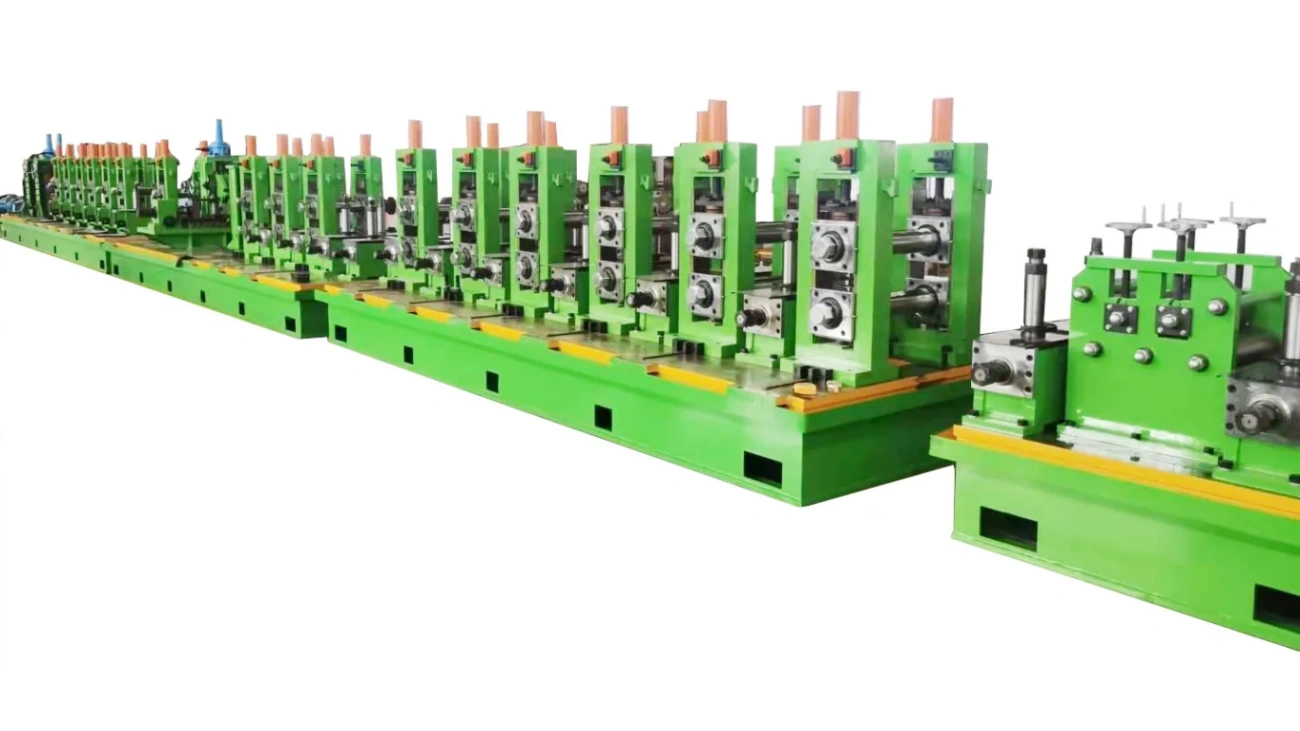
Selection starts with the largest outside diameter the plant intends to sell. That number decides the welding technology; the technology decides the model step, the welder power band and the line layout. The three films set the smallest and largest high-frequency steps beside the spiral route, and more films are in the video library.
Compare the Mill Types Side by Side
Smallest HFW step, largest HFW step, and the spiral route.
Choosing by Target Outside Diameter
High-frequency longitudinal welding is practical to Φ630 mm; above that, spiral submerged-arc welding is what makes the pipe. Diameter is the first and largest fork in the decision, and it is not a preference — it is a physical boundary.
A plant that intends to sell line pipe, large-diameter water main or heavy structural section above Φ630 mm is choosing an SSAW spiral welded pipe mill whether or not it started the search expecting to, and a plant whose whole range sits below that ceiling gains nothing from spiral capability it will not use.
On the high-frequency side Tengtian builds twelve model steps, HG32 through HG630, and each step covers a diameter band rather than a single size. Each step is set out in full under the small-diameter HFW tube mill and the large-diameter HFW tube mill.
HG32 Φ10–32 · HG50 Φ16–50.8 · HG76 Φ25–76 · HG89 Φ32–89 · HG114 Φ45–114 · HG165 Φ60–165 · HG219 Φ114–219 · HG273 Φ114–273 · HG325 Φ165–325 · HG426 Φ165–426 · HG508 Φ219–508 · HG630 Φ325–630 (mm)
Bands overlap deliberately, so a plant whose product range straddles two steps usually has a real choice, and that choice is decided by where the volume sits, not by the extreme.
The overlap is worth reading carefully rather than skimming. HG76 covers Φ25–76 mm while HG89 starts at Φ32 mm; HG273 covers Φ114–273 mm while HG325 starts at Φ165 mm. A plant whose main product is Φ150 mm can be served by HG165, HG219 or HG273 — three steps — and the right one is decided by what sits either side of that main product, not by the number itself.
Wall thickness is the second constraint and it is not independent of diameter. Across the high-frequency range the mills handle 0.5–16 mm; on the spiral side the 820 class runs 3–12 mm and the 1620 class 5–16 mm. A requirement that is thin-wall at large diameter, or heavy-wall at small diameter, narrows the options faster than the diameter alone suggests.
Section shape narrows them further. Round, square and rectangular sections all come off high-frequency lines, and square tube has a dedicated route — direct forming, where size is changed by combined dies instead of by changing rolls and roll consumption falls by more than 90%. Spiral lines make round pipe only. One exception is worth stating: making 100 × 100 mm tube needs the upper roll on the final open stand changed.
On the spiral side there are two machine classes: Φ219–820 mm × 3–12 mm, and Φ219–1620 mm × 5–16 mm. Within a class, diameter is changed by changing the forming angle rather than by changing rolls, which is why one spiral mill covers so wide a band.
Welder Power Band: 150 kW to 1500 kW by Size Class
Welder power is matched to diameter in steps across the range 150–1500 kW. Under-powering gives lack of fusion; over-powering gives burn-through — so the rating is sized to the pipe rather than bought as headroom.
The two endpoints are HG32 = 150 kW and HG630 = 1500 kW. The rating of each intermediate model (HG50 / HG76 / HG89 / HG114 / HG165 / HG219 / HG273 / HG325 / HG426 / HG508) is quoted per project against the actual product mix — diameter band, wall thickness, line speed and duty — rather than read off a model number.
Spiral mills are rated differently: the Φ219–820 class carries a main installed capacity of about 200 kW including welding, and the two classes also differ in welding arrangement — outer-single/inner-single on the 820 class, outer-double/inner-single on the 1620 class.
HFW or SSAW for Your Diameter and Application
| HFW — high-frequency longitudinal | SSAW — spiral submerged-arc | |
|---|---|---|
| Diameter range | Φ10–630 mm, 12 model steps (HG32–HG630) | Φ219–820 mm and Φ219–1620 mm, 2 classes |
| Wall thickness | 0.5–16 mm | 3–12 mm (820 class) / 5–16 mm (1620 class) |
| Seam | Straight longitudinal, HF induction, no filler | Helical, automatic submerged arc, inside and out |
| Size change | By changing rolls (or by combined dies on direct-square lines) | By changing forming angle — no roll change |
| Production mode | Continuous | Discontinuous |
| Welding speed | Set per model and wall thickness; the line does not stop between coils | 0.5–3 m/min |
| Section shapes | Round, square, rectangular | Round |
| Suits | Higher volume at small and medium diameter | Large diameter, medium batch, heavy wall |
An API line-pipe mill is a high-frequency line plus intermediate-frequency annealing, straightening, end facing, hydrostatic testing, ultrasonic and eddy-current inspection, and covers OD 114–508 mm at 3–20 mm wall by class. Application decides more of this than the equipment list suggests: long-distance oil and gas transmission line pipe changes the line rather than the paperwork.
Spiral lines carry their own inspection chain and are built against GB/T 9711 and, on the 1620 class, API SPEC 5L.
The overlap band Φ219–630 mm is where both technologies can make the pipe.
Within that band, wall thickness narrows the choice further: the HG508 and HG630 run 4–16 mm wall, the 820 spiral class 3–12 mm and the 1620 class 5–16 mm, so heavy wall alone does not force the spiral route.
What decides it is batch size, wall thickness and the standard the finished pipe must meet — a spiral line changes diameter without changing rolls, which favours a wide product range in medium batches; a longitudinal line runs continuously between coils, which favours volume in a narrower range.
Ask an Engineer — Talk to Our After-Sales Team →
More in Watch the Lines Running
From the Workshop
Send Your Enquiry
Tell us the pipe outside-diameter range, the wall thickness and the output you need. An engineer reads every enquiry — it does not land in a general sales inbox.