
Home › Resources › Watch the Lines Running › Inspection Videos
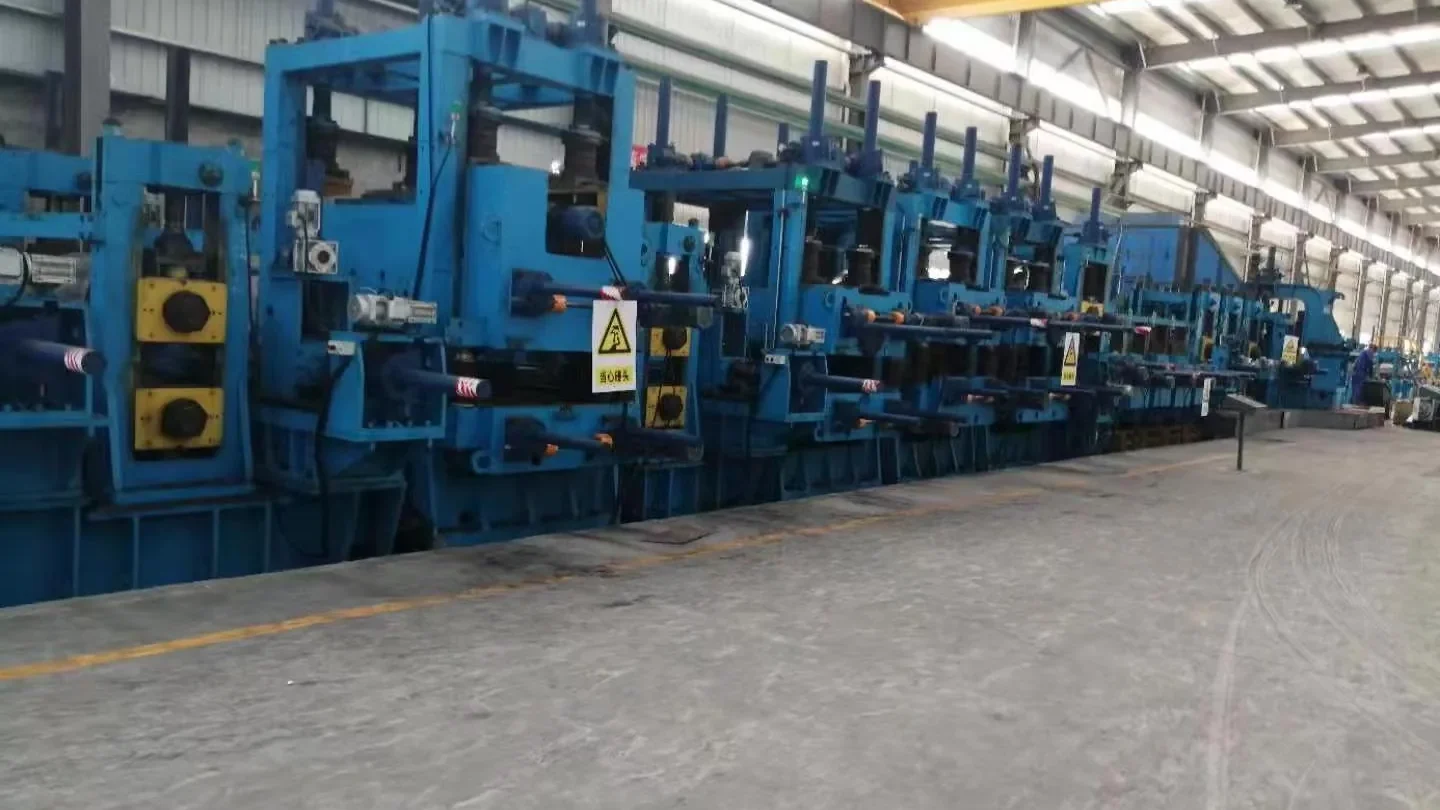
Three inspection stations sit on the finishing line of the Φ219–1620 mm SSAW spiral welded pipe mill: X-ray at 225 kVA, a 1200-tonne hydrostatic tester and off-line ultrasonic. More films of the lines running are in the video library.
Inspection and Finishing on the Line
Two lines that carry inspection stations: the spiral mill and the API line pipe mill.
Why the Inspection Chain Decides the Order
Whether a spiral weld passes X-ray, hydrostatic and ultrasonic testing in one pass is the order threshold for energy and line-pipe work: a defect that leaves the works becomes a claim.
Each of the three stations has a published capability figure, a coverage definition and a standard it is built against. Wall thickness, line speed and shift output are confirmed at quotation against the pipe size, material grade and cut length.
X-Ray Inspection: 225 kVA, 0.8–1.2% Sensitivity, 40 mm Fe Penetration
The X-ray station images the spiral weld to detect internal defects. Published capability:
- Tube rating 225 kV / 8 mA (225 kVA class)
- Maximum penetration 40 mm Fe
- Static sensitivity 0.8–1.2%
- Inspection speed 0.5–10 m/min
- Applicable to Φ219–1620 mm, pipe length ≤ 12 m
Imaging is by digital flat panel. Standards referenced at this station: GB/T 26830-2011, ISO 10893-7 single-wall class B, GB/T 9711-2017 and API SPEC 5L (46th edition); radiation protection to GBZ-117-2015 and GBZ/T 250-2014.
The X-ray tube and its cooler are wear items, water-cooled at a flow above 4 L/min with inlet water not exceeding 35 °C. Weld tracking uses laser image capture, which keeps the station on the seam rather than near it.
What moves the result is tube voltage and current, inspection speed, and block calibration — which is why the sensitivity figure is quoted as a static value against a test block rather than as a general claim.
1200-Tonne Hydrostatic Test with Computer-Monitored Printed Record
The hydrostatic tester proves pressure integrity of the pipe body and the weld. Published capability:
- 1200-tonne frame, Φ800 mm main cylinder, 31.5 MPa high-pressure pump
- Four tension beams, 16Mn 600 × 80, pin holes Φ150 42CrMo, safety factor 4
- Applicable to Φ219–1620 mm, 8–12 m pipe
PLC plus computer monitoring logs pressure and hold time for each test, and the record is printed.
| Station | Quantified capability | Coverage | Standard basis |
|---|---|---|---|
| X-ray | 225 kV / 8 mA · 40 mm Fe penetration · static sensitivity 0.8–1.2% · 0.5–10 m/min | Spiral weld, Φ219–1620 mm, ≤ 12 m | GB/T 26830-2011 · ISO 10893-7 single-wall B · GB/T 9711-2017 · API SPEC 5L (46th) |
| Hydrostatic | 1200 t frame · Φ800 main cylinder · 31.5 MPa pump · safety factor 4 | Pipe body and weld, Φ219–1620 mm, 8–12 m | Pressure and hold logged; computer-monitored printed record |
| Off-line ultrasonic | 0.5–15 MHz · 32 channels pipe body / 8 channels weld · false-call ≤ 2% · zero missed calls on sample pipe | Weld 100% · HAZ 25 mm each side · pipe body ≥ 35% | GB/T 9711-2017 · API SPEC 5L (46th) |
Off-line ultrasonic completes the chain and is the station with the widest coverage definition: weld 100%, heat-affected zone 25 mm each side, and pipe-body base material at 35% or better, using water-film coupling and multi-channel probes at 0.5–15 MHz — 32 channels on the pipe body and 8 on the weld.
Published performance is a false-call rate of 2% or less with zero missed calls on the sample pipe. Acceptance is against GB/T 9711-2017 and API SPEC 5L (46th edition).
The finishing sequence these stations sit in runs: weld repair → pipe-end alignment → X-ray → 1200-tonne hydrostatic → off-line ultrasonic → end facing and bevelling. Each station passes, reworks or rejects; repaired welds are re-inspected. Pipe-end dead zone is ≤ 300 mm.
A related but separate chain applies to API line pipe on the high-frequency side: the API line pipe mill adds intermediate-frequency annealing, straightening, end facing, hydrostatic testing, ultrasonic and eddy-current inspection to a standard welded-tube line, covering OD 114–508 mm at 3–20 mm wall by class.
Ask an Engineer — Talk to Our After-Sales Team →
More in Watch the Lines Running
From the Workshop
Send Your Enquiry
Tell us the pipe outside-diameter range, the wall thickness and the output you need. An engineer reads every enquiry — it does not land in a general sales inbox.