
Home › Resources › Welded Pipe Guide › Seamless Pipe vs Welded Pipe
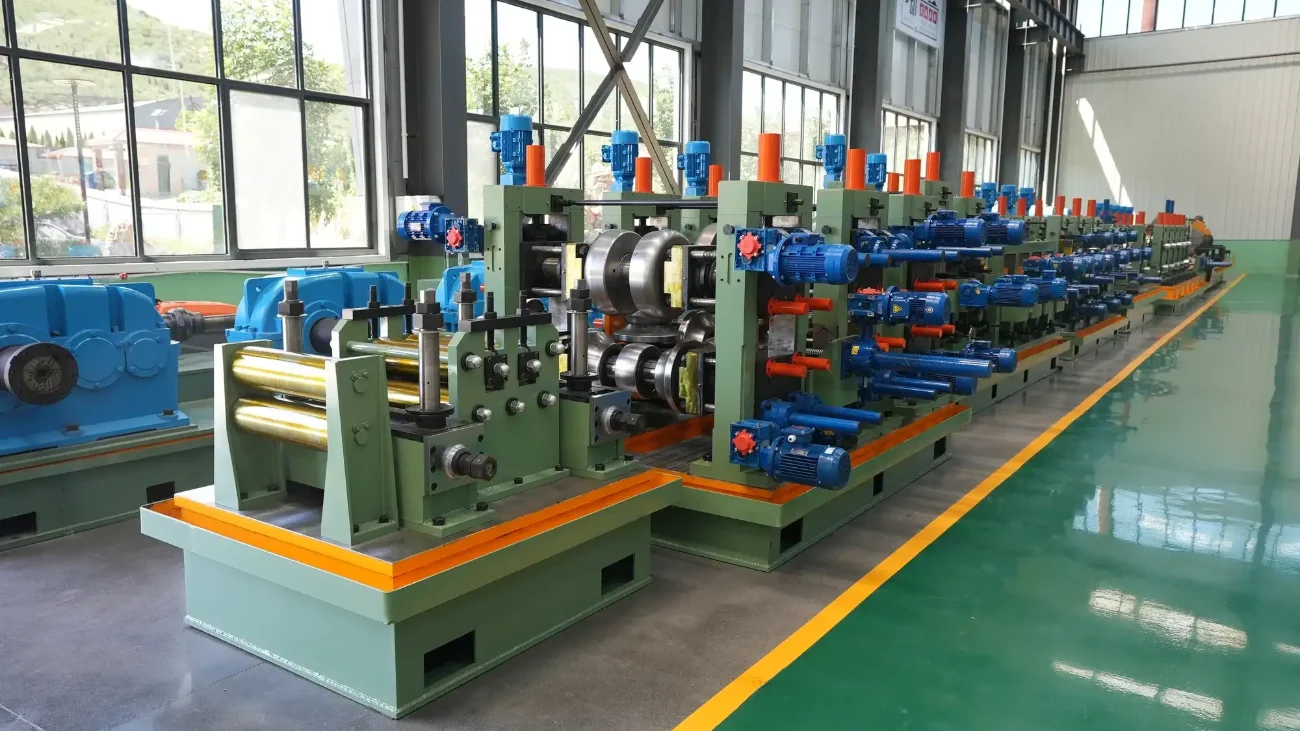
Tengtian builds welded pipe lines, not seamless mills: two welding routes, high-frequency and spiral submerged-arc, across twelve high-frequency size classes and two spiral classes, each tested to its own standards. Seamless pipe is made on entirely different plant, so we compare it in direction only — cost, continuity and diameter fit — never with figures.
Which Welded Route, and How It Compares With Seamless
- The welded side is in two routes: high-frequency longitudinal (HFW/ERW) and spiral submerged-arc (SSAW).
- Diameter coverage: Φ10–630 mm across twelve HFW size classes, and Φ219–1620 mm across two spiral classes.
- Standards differ by line and class: GB/T 9711 and GB/T 5037 on the Φ820 spiral class, GB/T 9711 and API 5L on the Φ1620 class.
- Against seamless rolling, the high-frequency route is lower in investment and running cost, more continuous, and suited to small and mid diameters made in volume.
What Is Seamless Pipe vs Welded Pipe
The difference is how the pipe body is closed. A welded pipe starts as flat strip that is formed into a shell and joined along a seam; a seamless pipe is pierced from a solid billet and has no seam at all.
Pipe from the spiral line goes into four uses: oil and gas line pipe, low-pressure fluid and urban gas pipe, water supply and drainage pipe, and industrial structural pipe.
For the high-frequency lines the uses are fluid transport pipe — oil and gas, municipal water and gas, chemical and heating pipework — and structural and scaffolding tube.
ERW pipe vs seamless cost
The answer is one of direction, not magnitude: the high-frequency welded route carries lower investment and lower running cost than seamless rolling. Wall thickness, line speed and shift output are confirmed against your pipe size, material grade and cut length at quotation. Send us those three and we will state the figures.
On the welded side, running cost over time comes down to: low roll wear, high yield and quick changeover.
Seamless Pipe vs Welded Pipe Explained
The welded side is two distinct processes, not one, and Tengtian builds both: the tube mill & welded pipe production line for high-frequency longitudinal welding (HFW/ERW), and the SSAW spiral welded pipe mill for spiral submerged-arc welding. Terms used along the way are explained in the tube & pipe mill glossary.
The two are separated by more than seam direction. Compared with high-frequency longitudinal welding, the spiral route uses a spiral seam and submerged-arc welding instead of a longitudinal seam and high-frequency welding, and changes diameter by changing the forming angle rather than by changing rolls.
That gives one machine a wide diameter span and the ability to make large-diameter heavy wall — up to Φ1620 × 16 mm at 7.5 tonnes per pipe — but at a lower welding speed of 0.5 to 3 m/min and in discontinuous production, which suits large diameters in small to medium batches.
There is a hard boundary between the two welded routes, and it is the reason the spiral line exists at all. The high-frequency line is bounded at Φ630 mm.
A buyer who needs line pipe, water pipe or structural pipe above that diameter has to move to spiral submerged-arc; and because one spiral machine covers Φ219–1620 mm by changing the forming angle, that buyer does not have to build a separate line for each diameter class.
The high-frequency side has its own reason for existing, and it is about continuity rather than diameter. The core need it answers is continuous production without stopping — the spiral accumulator keeps the mill fed while coils are changed — plus one line covering multiple sizes, stable yield and weld quality, and changeover efficiency.
ERW vs LSAW pipe
Against UOE/JCOE longitudinal submerged-arc, the spiral route is lower in equipment investment and floor area and more flexible in size switching, because it forms continuously from strip coil. Against the same alternative, the high-frequency route is lower in investment and running cost and more continuous. These comparisons are qualitative.
Put the other way round, the high-frequency route is the faster one: higher welding speed, a longitudinal seam, and a fit with structural and ordinary fluid pipe.
Side-by-Side Comparison Table
| High-frequency welded (HFW/ERW) |
Spiral submerged-arc (SSAW) |
Seamless | |
|---|---|---|---|
| How the pipe is made | Strip roll-formed into a tube; seam closed by high-frequency pressure welding, no filler | Strip fed at an angle and welded in a spiral seam by submerged arc, inside and out | Solid billet pierced and rolled; no seam |
| Seam | Straight | Spiral | None |
| Diameter on our lines | Φ10–630 mm, twelve classes | Φ219–820 / Φ219–1620 mm, two classes | Not built by Tengtian |
| Wall on our lines | 0.5–16 mm | 3–12 / 5–16 mm | — |
| Production | Continuous; the accumulator keeps the mill fed while coils are changed | Discontinuous; welds at 0.5–3 m/min | — |
| Changing size | Change rolls | Change the forming angle | — |
| Standards on our lines | API 5L on the API configuration | GB/T 9711 and GB/T 5037 (Φ820); GB/T 9711 and API 5L (Φ1620) | — |
| Investment and running cost | Lower than seamless rolling and UOE/JCOE | Lower equipment investment and floor area than UOE/JCOE | Higher than HFW |
| Best fit | Small and mid diameters in volume; structural and fluid pipe | Large diameter and heavy wall in small to medium batches; line, water and structural pipe | — |
Seamless pipe is hot-worked on entirely different plant, so seamless-side figures are best confirmed with the builders of those mills.
How to Decide: Target Diameter, Application and Volume
The HFW range spans twelve classes: Φ10–32, 16–50.8, 25–76, 32–89, 45–114, 60–165, 114–219, 114–273, 165–325, 165–426, 219–508 and 325–630 mm. Target diameter is the first cut and the primary selection dimension. The spiral line comes in two classes, Φ219–820 × 3–12 mm and Φ219–1620 × 5–16 mm.
Application is the second cut, defined by downstream use. For the spiral line the uses are oil and gas line pipe, low-pressure fluid and urban gas pipe, water supply and drainage pipe, and industrial structural pipe. For the HFW lines the uses are fluid transport pipe and structural and scaffolding tube.
Standards are the third cut, and each line is tested to specific standards. The Φ820 spiral class is built to GB/T 9711 and GB/T 5037; the Φ1620 class is built to GB/T 9711 and API 5L, with GB/T 9711-2017 and API SPEC 5L (46th edition) cited at the X-ray and ultrasonic stages.
Volume is the fourth cut. The spiral line’s output is quoted with its basis: about 62 tonnes per 8-hour shift on the Φ820 class, on 1050 mm strip at 12 mm wall making Φ820 × 12 m pipe, roughly 21 pipes at 3 tonnes each; and about 120 tonnes per shift on the Φ1620 class, on 1250 mm strip at 16 mm wall making Φ1620 × 12 m pipe, roughly 15 pipes at 7.5 tonnes each.
Two-shift annual output on the Φ820 class is set at 10,000 to 20,000 tonnes.
Inspection is the fifth cut, and it is the one large-diameter buyers are most sensitive to. The spiral line can be supplied with a complete inspection chain: a 225 kVA X-ray unit, a 1200-tonne hydrostatic tester and offline ultrasonic.
The coverage is defined in numbers — 100% of the weld, 25 mm either side of the heat-affected zone, and not less than 35% of the pipe body — accepted to GB/T 9711-2017 and API SPEC 5L (46th ed.), with laser image capture used for weld tracking.
That matters because large-diameter pipe makers work to project orders and are sensitive to standards and to the inspection chain: what they are checking is whether the diameter and wall coverage reach far enough, whether the chain is complete enough to deliver compliant pipe, and whether output matches the project milestones.
On the spiral line the maximum wall thickness is not a single number: a capacity table sets the maximum wall per steel grade and diameter across Q235, Q355 and L360, and exceeding it has known consequences — forming force falls short, the strip will not roll, or the pipe shape comes out wrong.
The order of decision is therefore grade first, then wall.
Frequently Asked Questions
What is the practical difference between the two? The comparison is qualitative and runs one way only. Against seamless rolling and UOE/JCOE, the high-frequency welded route is lower in investment and running cost, more continuous in operation, and suited to mid and small diameters made in volume.
Which one suits my target diameter and application? Diameter decides first. The HFW range is Φ10–630 mm across twelve size classes; the spiral range is Φ219–1620 mm across two classes.
Above Φ630 mm the reason is plain: the high-frequency line is bounded at Φ630, so large-diameter line pipe, water and structural pipe have to go to spiral submerged-arc. Application then narrows it further, with the spiral line for line pipe, gas, water and structural use.
How do running costs compare? The high-frequency route is lower in investment and running cost than seamless rolling and UOE/JCOE, and the spiral route is lower in equipment investment and floor area than UOE/JCOE. On the welded side, the factors that keep running cost down are low roll wear, yield that can reach 93% or more on high-end configurations, and quick changeover. The comparison is qualitative; no cost figures are quoted for any route.
Which standards apply to each? For the welded lines the applicable standards are specified line by line: GB/T 9711 and GB/T 5037 on the Φ820 spiral class, GB/T 9711 and API 5L on the Φ1620 class, with GB/T 9711-2017 and API SPEC 5L (46th ed.) cited at the inspection stages. Seamless pipe is made on plant we do not build, so its standards are best confirmed with the builders of seamless mills.
Our welded pipe equipment is CE marked under the EC Machinery Directive 2006/42/EC, and the company is certified to ISO 9001:2015.
Which option ships and commissions faster? Standard lines ship within 90 working days of the deposit, with plant-level customisation scheduled from our own manufacturing base; the term is the same for both welded routes. Commissioning takes two to three engineers on a high-frequency line, with the period set in the quotation, and five personnel — four engineers and an adjustment technician — over forty days on a spiral line.
Can one supplier provide both? Both welded routes, yes — one supplier covers high-frequency longitudinal and spiral submerged-arc in the same plant, with diameters running from Φ10 all the way to Φ1620 mm, so a buyer does not need a second supplier for large diameter.
Seamless is a different answer: Tengtian builds welded pipe lines, not seamless equipment of any kind, so a seamless mill is not something we supply.
From the Workshop
Send Your Enquiry
Tell us the pipe outside-diameter range, the wall thickness and the output you need. An engineer reads every enquiry — it does not land in a general sales inbox.