
In This Line
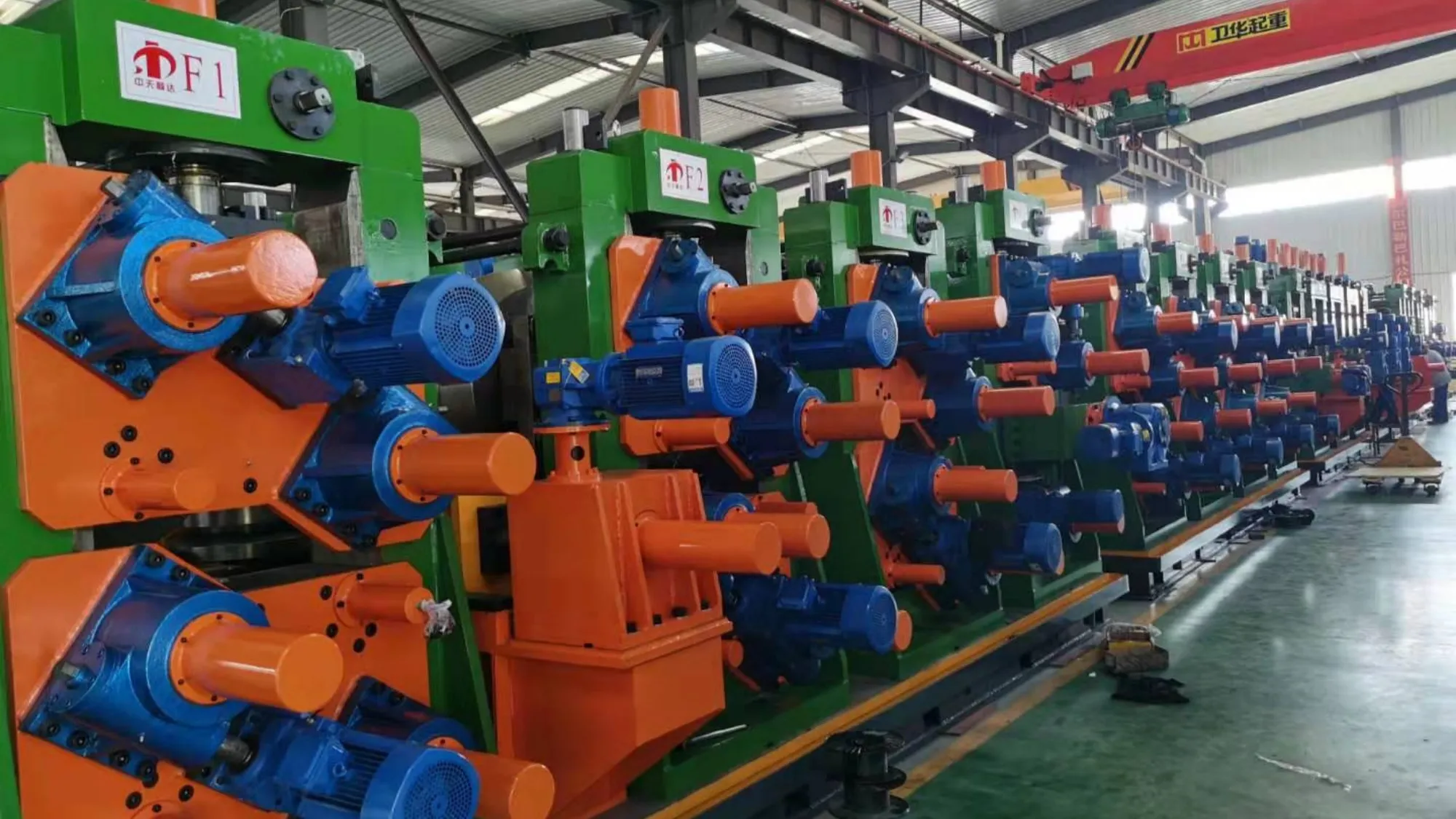
The strip is formed directly into a square section, and a PLC sets the roll positions. For most sizes, a size change is an adjustment on the same roll set rather than a roll change.
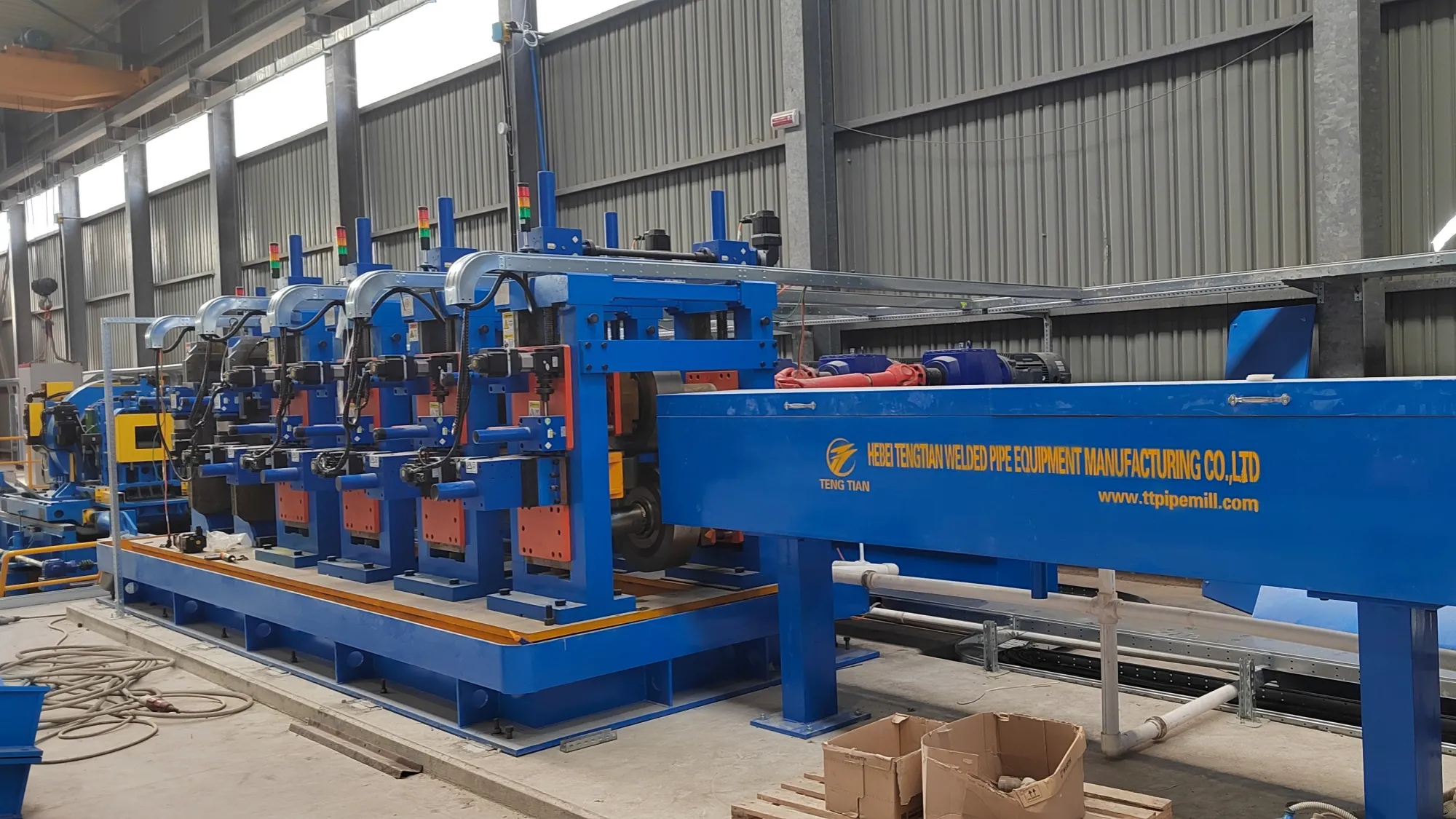
HGF150 Automatic Tube Mill Specifications
HGF150 is the model code in our enterprise standard: HGF stands for high-frequency welding, and 150 for the largest tube the line makes, 150 × 150 mm. Figures not listed below are confirmed in the quotation against your tube size, wall thickness and steel grade.
| Tube produced | Square and rectangular hollow sections |
|---|---|
| Size range | 70 × 70 mm to 150 × 150 mm |
| Wall thickness | 2.0–6.0 mm |
| Cut length | 4–6 m |
| Line speed | 20–60 m/min |
| Forming method | Direct forming square, with Turk’s-head push-square forming |
| Welding | High-frequency welding |
| High-frequency welder | 600 kW |
| Control | PLC with HMI; closed-loop automatic roll positioning |
| Steel | Q195, Q235B, Q355B; galvanised, mild, cold-rolled and hot-rolled strip |
| Mechanical properties | Tensile strength ≤ 500 MPa, yield strength ≤ 325 MPa |
| Strip | 2.0–6.0 mm thick, 280–600 mm wide |
| Coil | Inner diameter Φ508–610 mm; outer diameter Φ1200–2100 mm; up to 10 t |
| Tube standards | DIN59411, GB6728-2002 |
| Enterprise standard | Q/GYL TT01-2023 |
Why Direct Forming Square
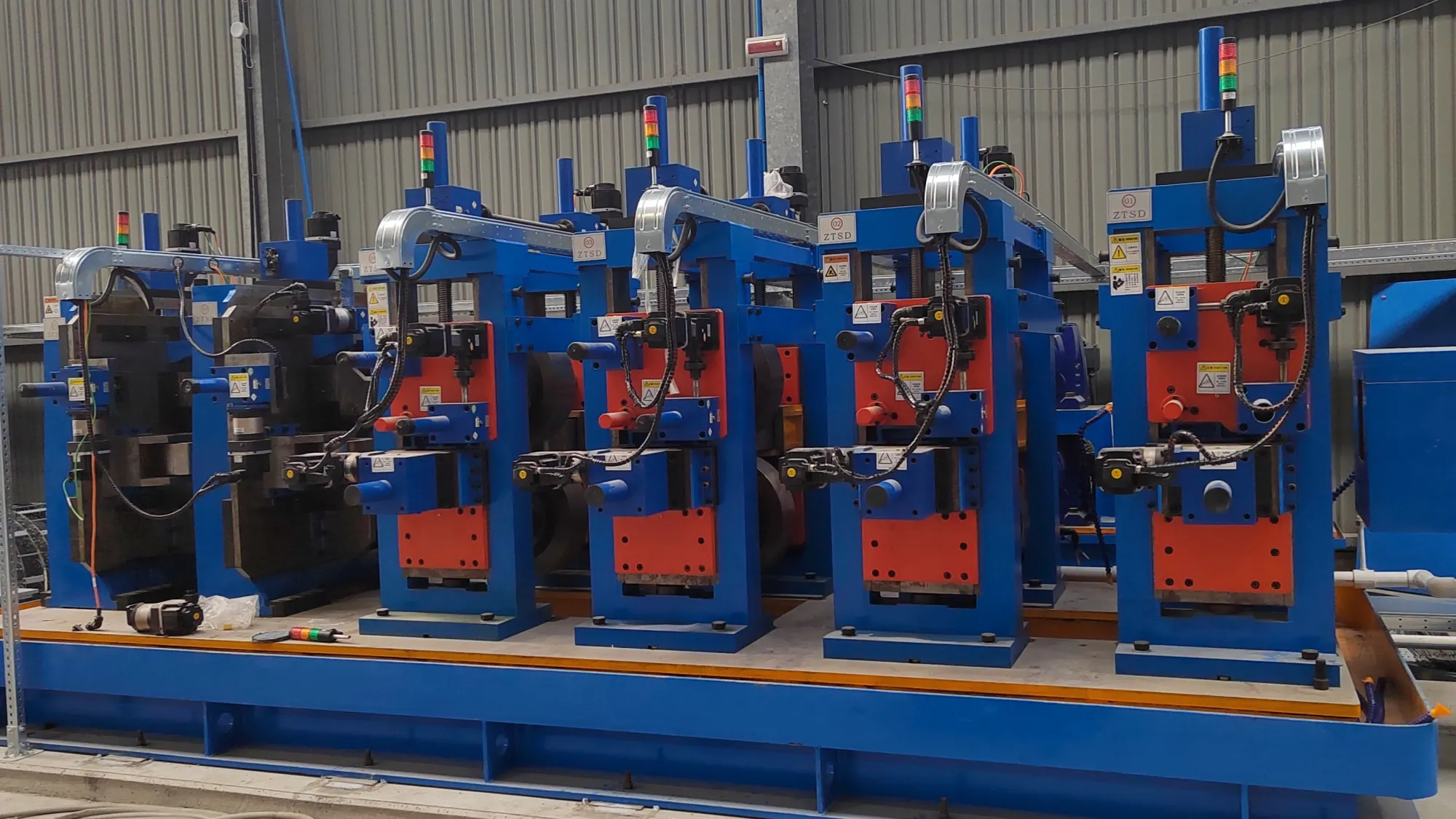
Direct forming bends the strip straight into a square or rectangular section. It takes fewer forming passes, saves material, uses less energy per tonne and lets one set of rolls serve many sizes, which is why it has become the main method for large square and rectangular tube in China.
- One combined roll set covers the size range. A new size means adjusting the rolls, not replacing them, and roll savings run above 90%. The one exception is 100 × 100 mm tube, which needs the upper roll on the final open stand changed.
- Roll adjustment is finished in a short time, so changeover time falls, output rises and running cost comes down.
- Servo motors make the adjustment, reducing the tools needed and the risk of damage to the machine at each changeover, and extending its service life.
- The composite roll touches the strip at points rather than along a line, which reduces roll wear and extends roll life.
From Strip to Finished Tube
The strip is bent at its four corners into an open rectangular shell and the seam is closed and welded by high-frequency current. The outside weld bead is scarfed off, and the tube is then water-cooled, sized, corrected for twist and straightened.
In the finishing stands, two driven horizontal rolls and two idle side rolls press on the tube walls, pushing the four corners toward a true 90° and tightening the corner radius. The upper roll is grooved to let the weld bead pass, so the top face does not sink.
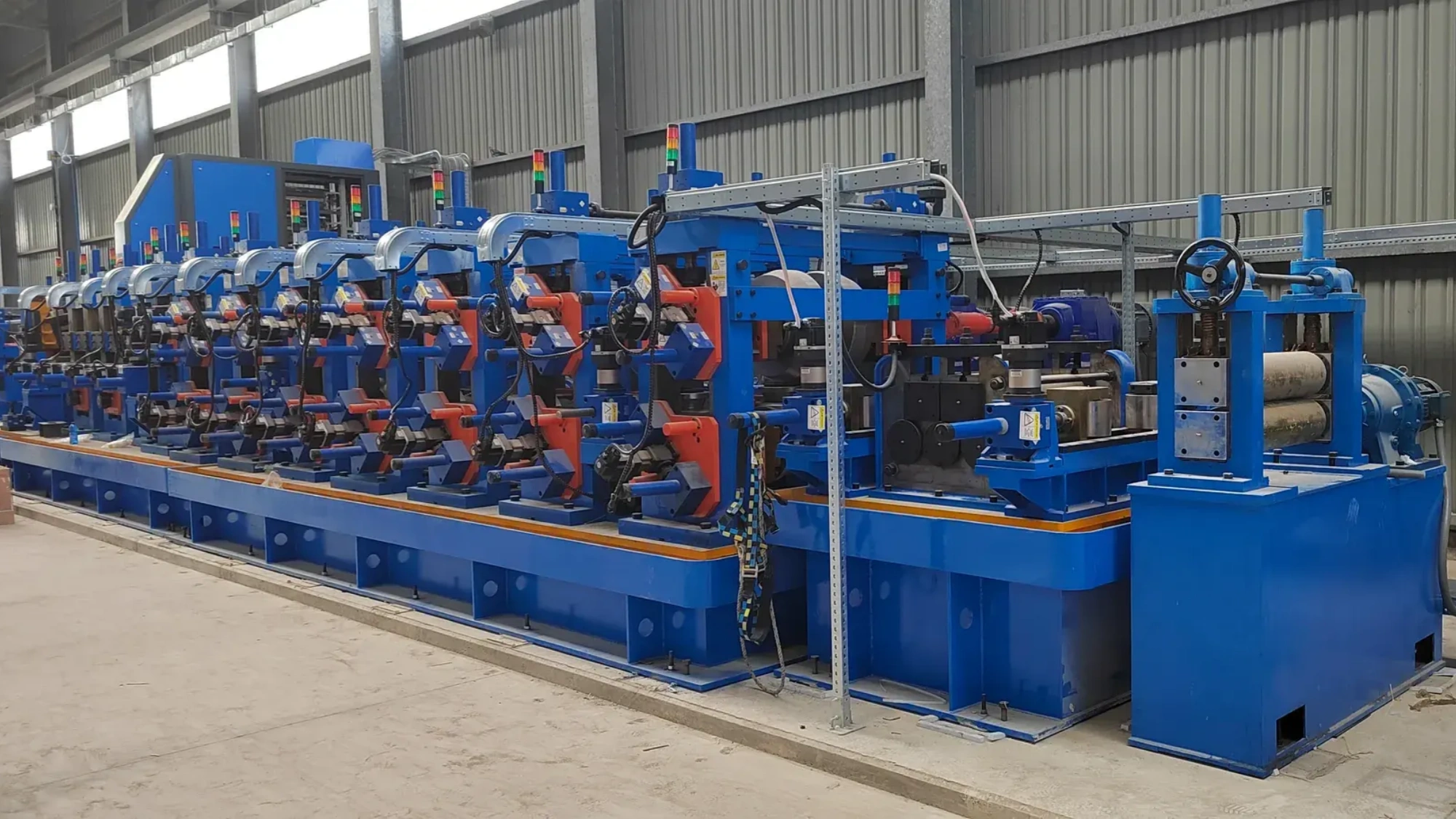
Line Configuration and Scope of Supply
- Coil car, which carries the coil to the uncoiler and lifts it so the bore sits on the uncoiler cone.
- Uncoiler with an expanding cantilever mandrel; expansion, contraction and braking are pneumatic.
- Head opener, which opens the coil head and leads the strip forward.
- Pinch roll and five-roll leveller, which flatten the strip before forming.
- Shear and butt welder, which crops the irregular strip ends and joins each coil to the next, so the line keeps running at a coil change.
- Horizontal spiral accumulator, which stores enough strip for the mill to keep forming while the next coil is uncoiled, sheared and joined.
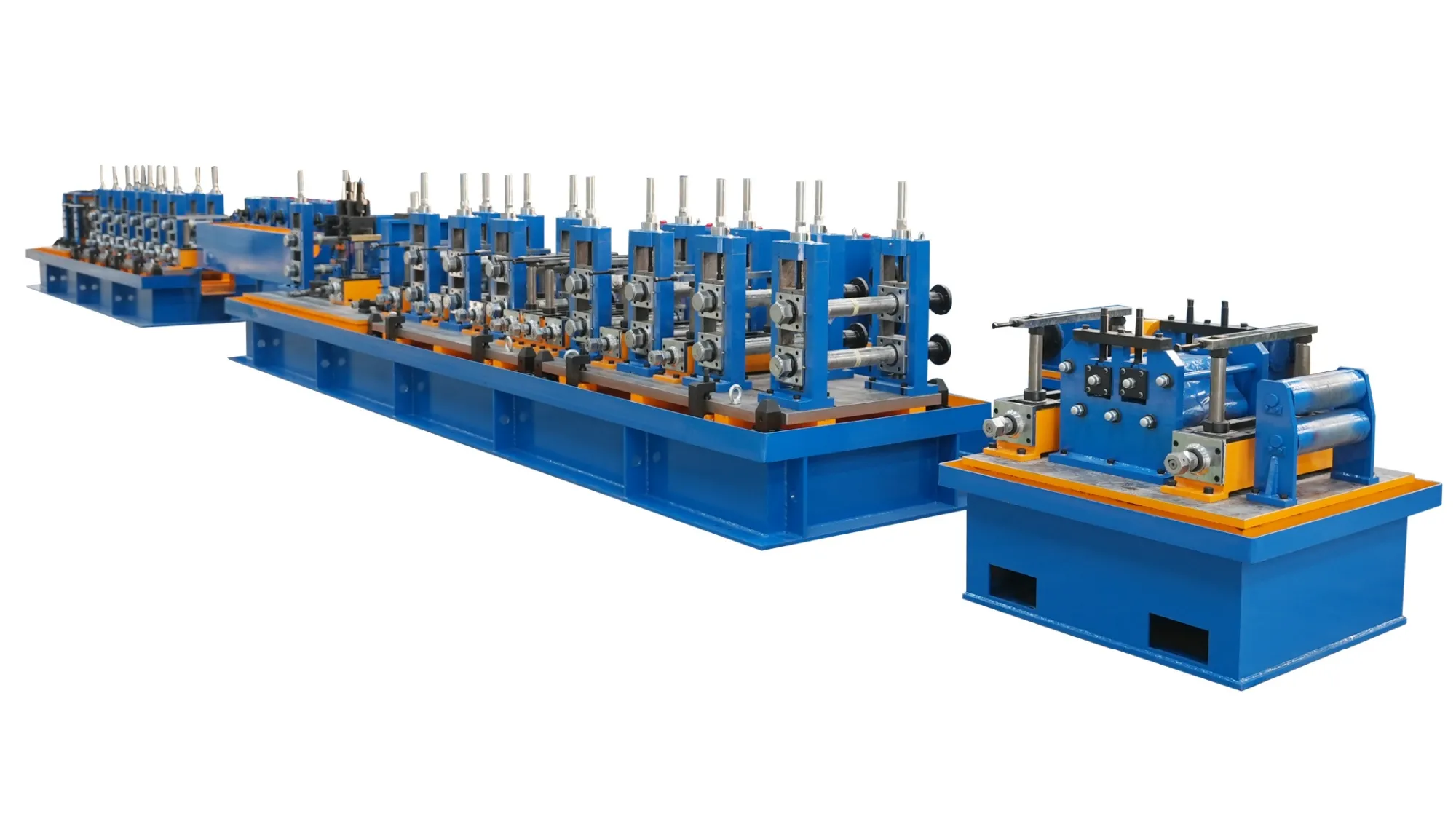
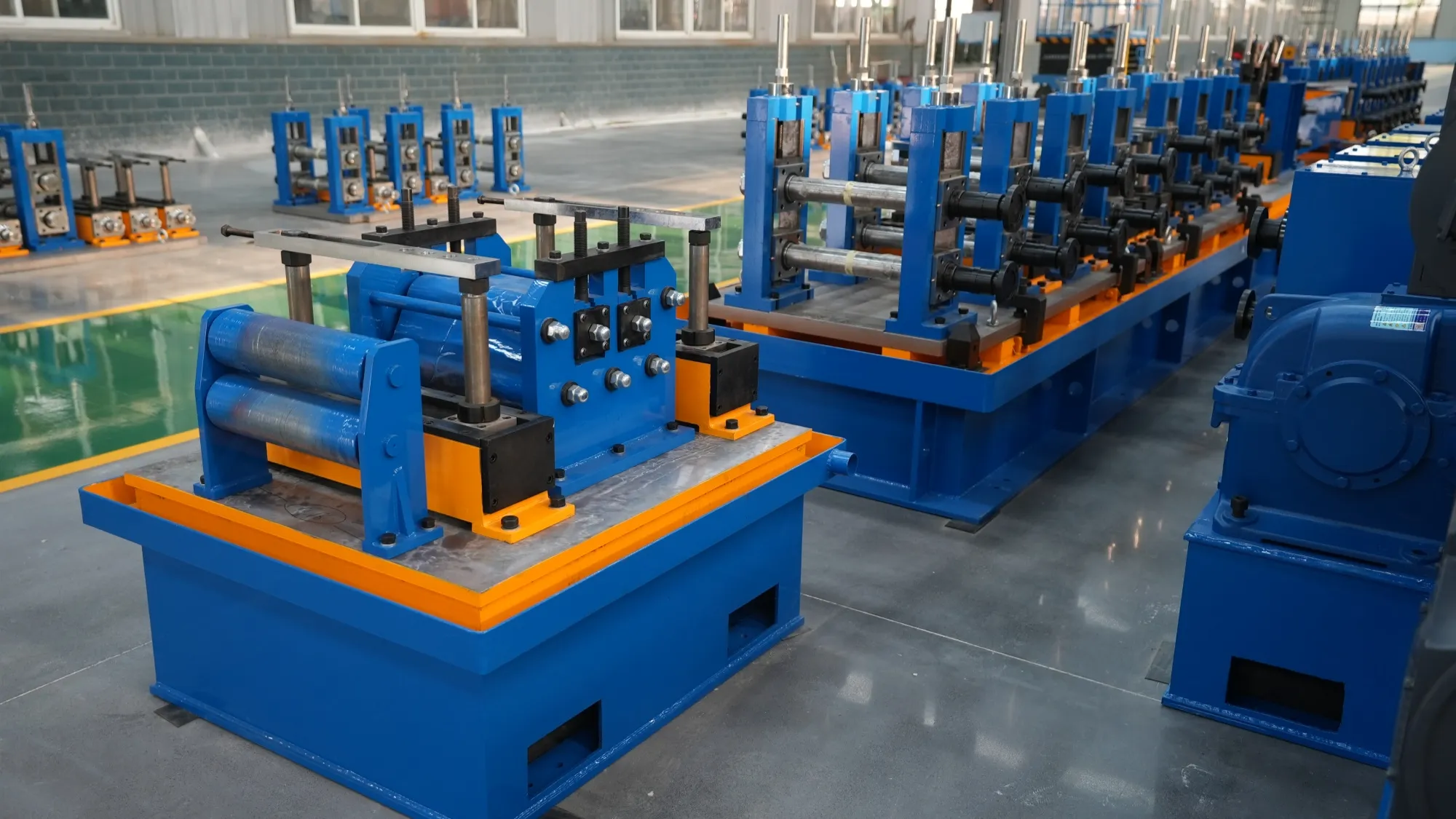
- Forming, welding, cooling and sizing mill, the core of the line.
- High-frequency welder, which welds the seam.
- Computer-controlled flying saw, which cuts to length while the tube keeps moving.
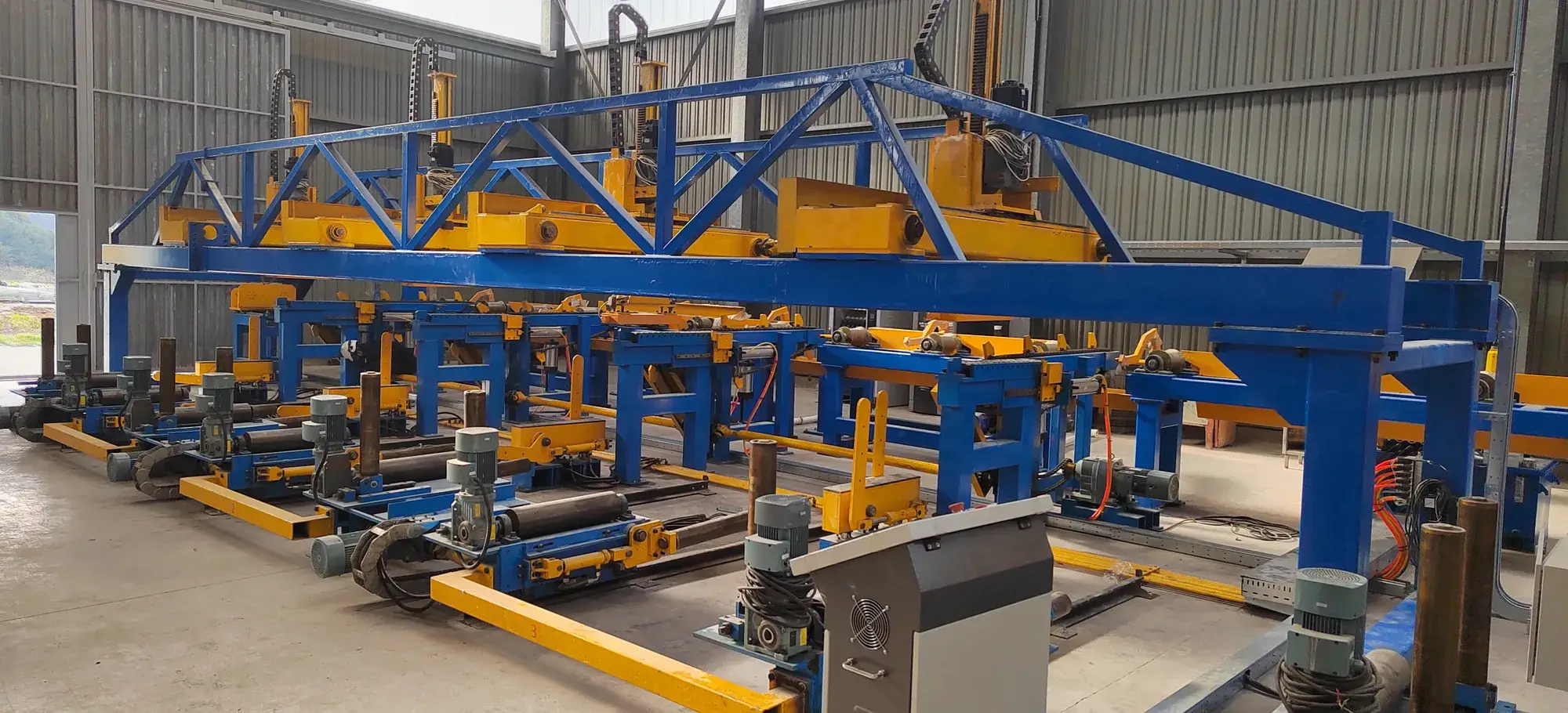
- Run-out table, hole punching, and fully automatic packing with stacking and strapping.
Inside the Forming and Sizing Mill
- Entry: feed rolls stop the strip moving up and down, automatic centring rolls (opening 120–400 mm) keep it on the mill centreline, and a passive roller leveller removes residual stress.
- Flat-roll forming stands with four independently adjusted rolls each. Servo motors and precision worm reducers open and close the two cantilever housings together, so the rolling centreline stays fixed across sizes; the upper roll also adjusts axially for strip thickness.
- Vertical roll stands between them. For a new size the rolls slide across the housing instead of being changed; their height is set by hand to suit the side height of each tube.
- Three closed-section bending stands, with upper and side rolls driven by 1.1 kW servo motors, keep the seam steady and untwisted into the squeeze rolls.
- A guide stand sets the opening angle and seam direction, and a five-roll squeeze stand closes the weld. Its side rolls adjust individually; its two upper rolls rise and fall together or singly and shift sideways to keep the seam on centre.
- Two outside-bead scarfing stands, one working and one on standby, followed by a smoothing stand and a cooling section.
- Four-roll sizing stands, with top, bottom and side rolls set crosswise; together with a lateral shift of the stand base, they switch between square and rectangular sizes.
- A Turk’s-head straightener at the exit, positioned by variable-frequency motors, corrects straightness.
- Each forming and sizing stand is driven by its own 15 kW motor through a reducer and a distribution gearbox.
PLC Tube Mill Control and Automatic Size Change
As a full-automatic pipe making machine, the line runs from a PLC with a human-machine interface. The PLC takes the signals from sensors along the line, runs each unit to the programmed sequence, and monitors equipment status for fault diagnosis.
Roll positions are set automatically. To change size, the operator enters the square size and wall thickness on a tablet, and every roll moves to its new position on its own, with no stand adjusted by hand. The control also remembers: each size plan can be saved and called up again the next time that size runs. PLC-controlled motors move each roll through gears and couplings, limit switches mark its zero point, and displacement sensors report where it actually is, closing the loop. This is what makes the HGF150 an automatic tube mill: in automatic mode every roll returns to zero before each size change and then moves to the set position for the new size. Maximum detection error is ±2 mm, and changeover accuracy is about 75% higher.
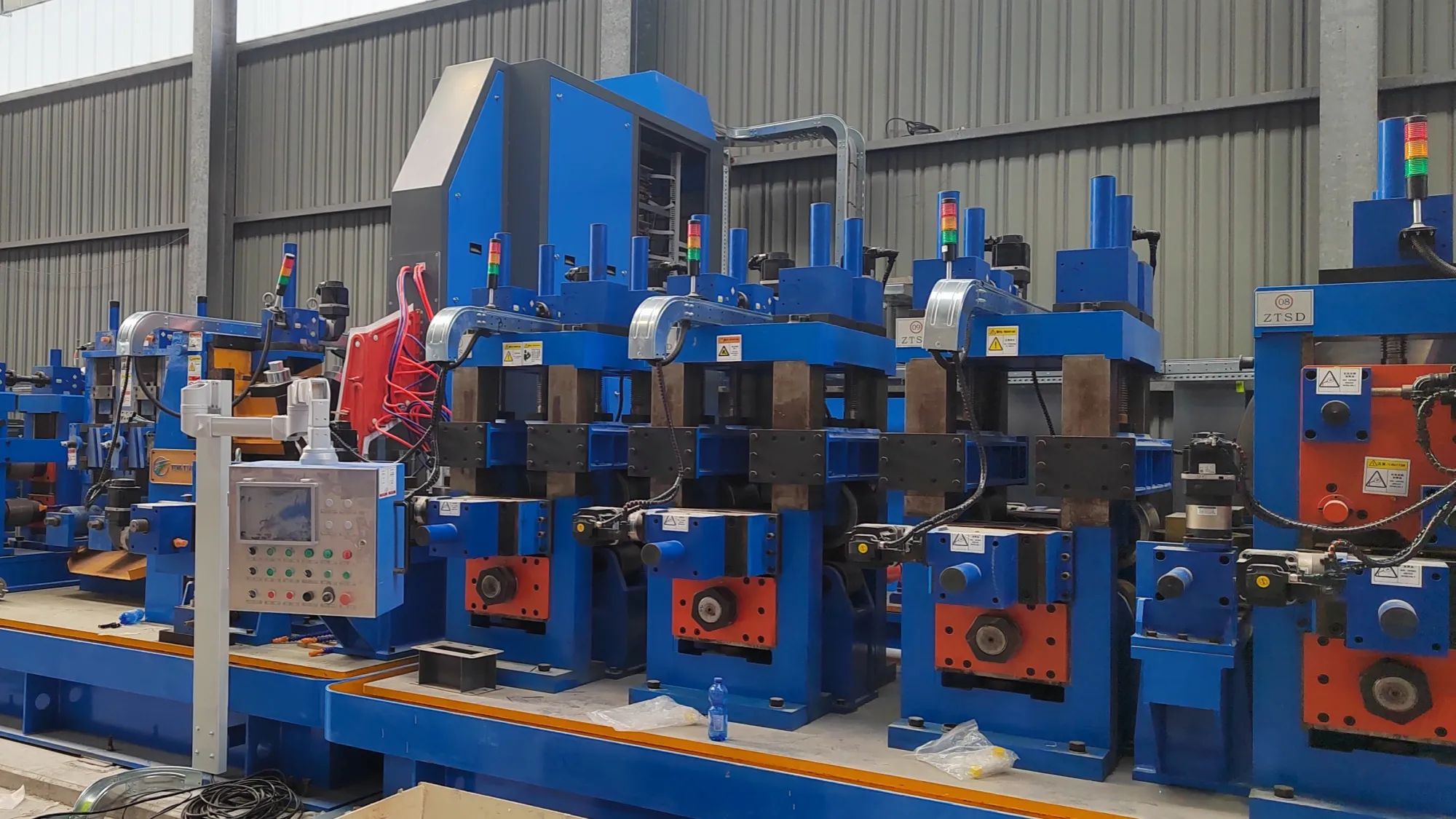
On the HMI, operators see the process flow live and handle alarms, real-time trends, history records and report printing. The control system provides standard interfaces for connection to a plant network and to other equipment.
Applications
Square and rectangular tube from this line goes into construction, structural steelwork, frames, and pipe and piping systems.
Delivery, Installation and Training
Standard lines ship within 90 working days of the deposit; larger lines are scheduled in the quotation.
After handover, support is a reply from our after-sales team, online support, on-site dispatch when needed, and direct spare-part shipment.
Behind that is our own engineering team, working from an owned production base that is open to factory audit.
Certification: GB/T 19001-2016 / ISO 9001:2015 (quality management system, certificate No. 18524Q11269R2S). The HGF150 is built to our enterprise standard Q/GYL TT01-2023, published on the national enterprise-standard platform.
Line Photos from the Works
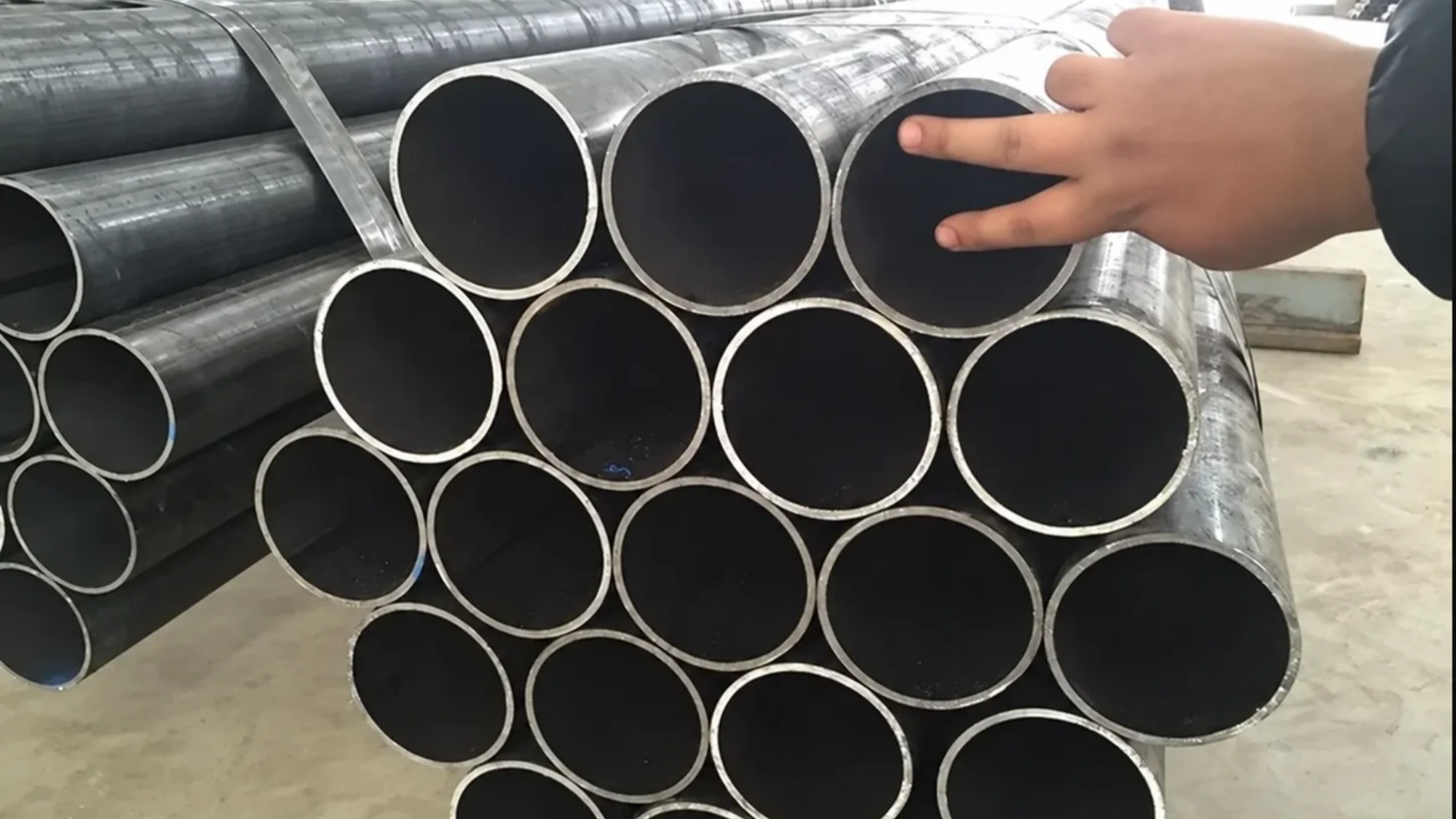
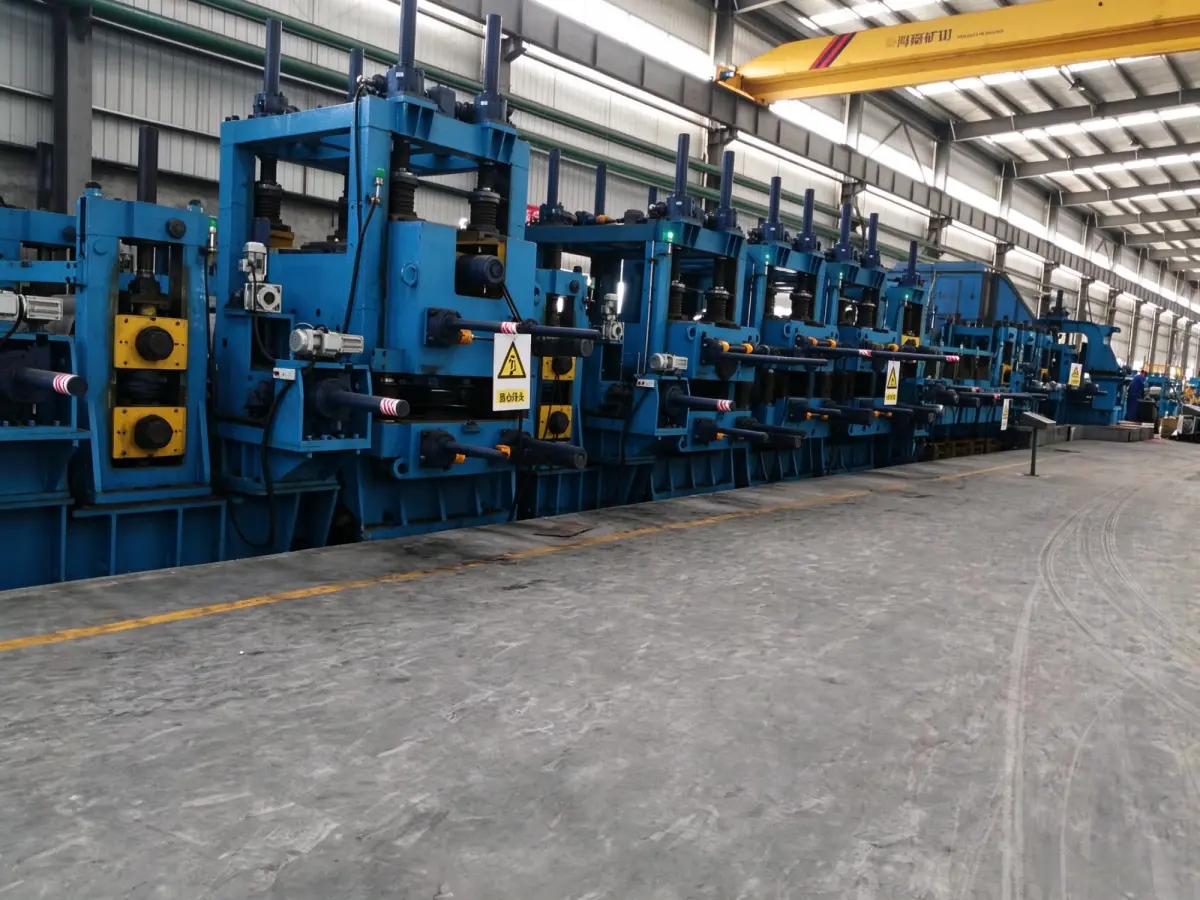
The run-out end of the line in our own workshop. Click the photo for the full-size image.
Watch This Line Running
Automatic Tube Mill 150×150 mm — PLC Full-Auto Line
 Tube Mill Machine for Steel Pipe Production
 Tube Mill Output, Material Yield and Roll-Change Cost in the Cold Forming Steel Process
 What Is an ERW Tube Mill
 The API Pipe Mill Inspection Chain
Send Your Enquiry
Tell us the pipe outside-diameter range, the wall thickness and the output you need. An engineer reads every enquiry — it does not land in a general sales inbox.