
Home › Resources › Knowledge Base › H Beam Welding Line GOST
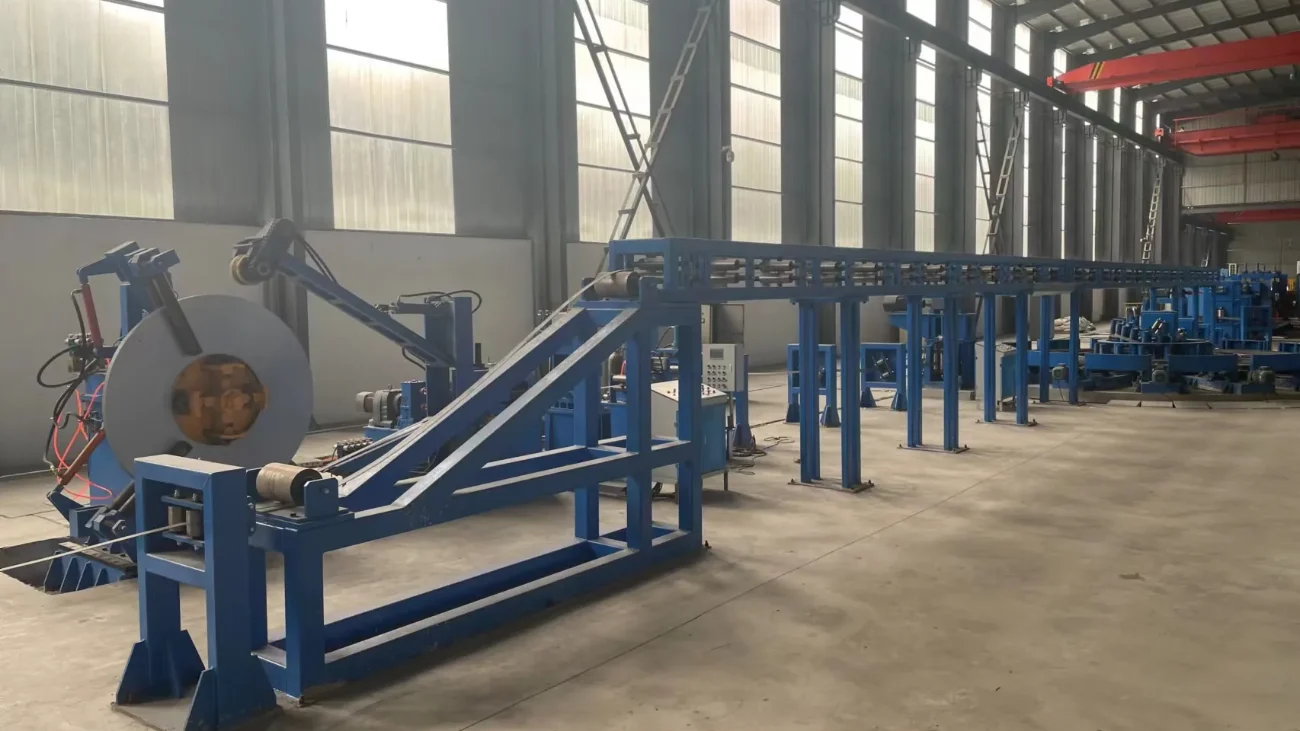
Tengtian’s H-beam production line is built to produce beams to GOST R 58966-2020, the Russian standard for welded H-beams. It covers beam height 147 to 450 mm, flange width 80 to 350 mm, and web and flange thickness 4 to 16 mm, optionally up to 20 mm.
The H-Beam Line and the Standard It Is Built To
- The line is built to produce HFW H-beams to GOST R 58966-2020.
- Size envelope: beam height 147–450 mm, flange width 80–350 mm, web/flange 4–16 mm, optionally to 20 mm.
- Steel grade coverage: 235–590 MPa, including С255, С345, С375, С390, С440, Powerweld 420 and 460.
- Annual capacity: not less than 100,000 tonnes.
What GOST R 58966-2020 Covers
GOST R 58966-2020 is the Russian standard for welded steel H-beams, and it is the product standard Tengtian’s H-beam line is built to: high-frequency welded H-sections made from hot-rolled slit coil, 147 to 450 mm high.
For the line, the standard settles two things: the product it has to make, and the link between strip grade and the mechanical properties of the finished beam, which is why the grades the line runs, С255 to С440 and Powerweld 420 and 460, are matched to the welding procedure. The same standard-first approach runs through the pipe lines: the API line pipe mill is configured to API 5L, and the SSAW spiral welded pipe mill to GB/T 9711.
What Tengtian supplies is a line configured to produce beams to this standard. That describes the machine; it is not a certificate for the finished beams.
Gost h beam production line
A GOST H-beam production line is a high-frequency welded line that forms and welds H-sections from hot-rolled slit coil and is set up to produce them to GOST R 58966-2020. Tengtian’s line is rated at not less than 20 t per hour for each listed section and not less than 100,000 t a year on two 12-hour shifts.
The full section table and the strip grades with their yield and tensile strengths are on the H-beam welding machine page.
Beam Sizes and Steel Grades This Line Covers
The size envelope is beam height 147 to 450 mm, flange width 80 to 350 mm, and web and flange thickness 4 to 16 mm with 20 mm noted as an option. These size ranges describe what the machine can make. Annual capacity is set at not less than 100,000 tonnes.
The material envelope is defined separately and in more detail. The line runs low-carbon and low-alloy hot-rolled strip, supplied as slit coil, across a strength band of 235 to 590 MPa; the named grades are С255, С345, С375, С390, С440, and Powerweld 420 and 460.
The dependency is direct: the strip grade determines the mechanical properties of the finished beam, and if the grade or the strip quality does not match, the beam fails on yield and tensile strength and its weldability suffers.
Measurement Method and Tolerance
Each section the line makes is specified by four dimensions: beam height, flange width, web thickness and flange thickness (H × B × t1 × t2), and the line’s section table lists 80 sizes on that basis. Dimensional tolerance, straightness and squareness values for the finished beam are not given in the line documentation, so no figures are quoted for them.
How the H-Beam Line Is Configured to Satisfy It
The forming and welding unit is a high-frequency welded H-beam line that welds and forms the beam, covering beam heights of 147 to 450 mm.
The quality-control point for the line is the pairing of strip grade with welding: grade and welding must match the GOST beam properties. This is a raw-material-and-process factor, and a mismatch leads to mechanical non-conformance.
The beams go into steel-structure buildings and other load-bearing frames, so the three figures to check against a project are the grade coverage, from yield strength 255 to 590 MPa, the web and flange thickness range, and the hourly and annual output.
The failure mode for the unit is that poor welding or forming produces flange and web dimensions, or mechanical properties, that do not conform.
More in the Knowledge Base
Send Your Enquiry
Tell us the pipe outside-diameter range, the wall thickness and the output you need. An engineer reads every enquiry — it does not land in a general sales inbox.