
Home › Resources › Knowledge Base › GB/T 9711 for Spiral Welded Line Pipe
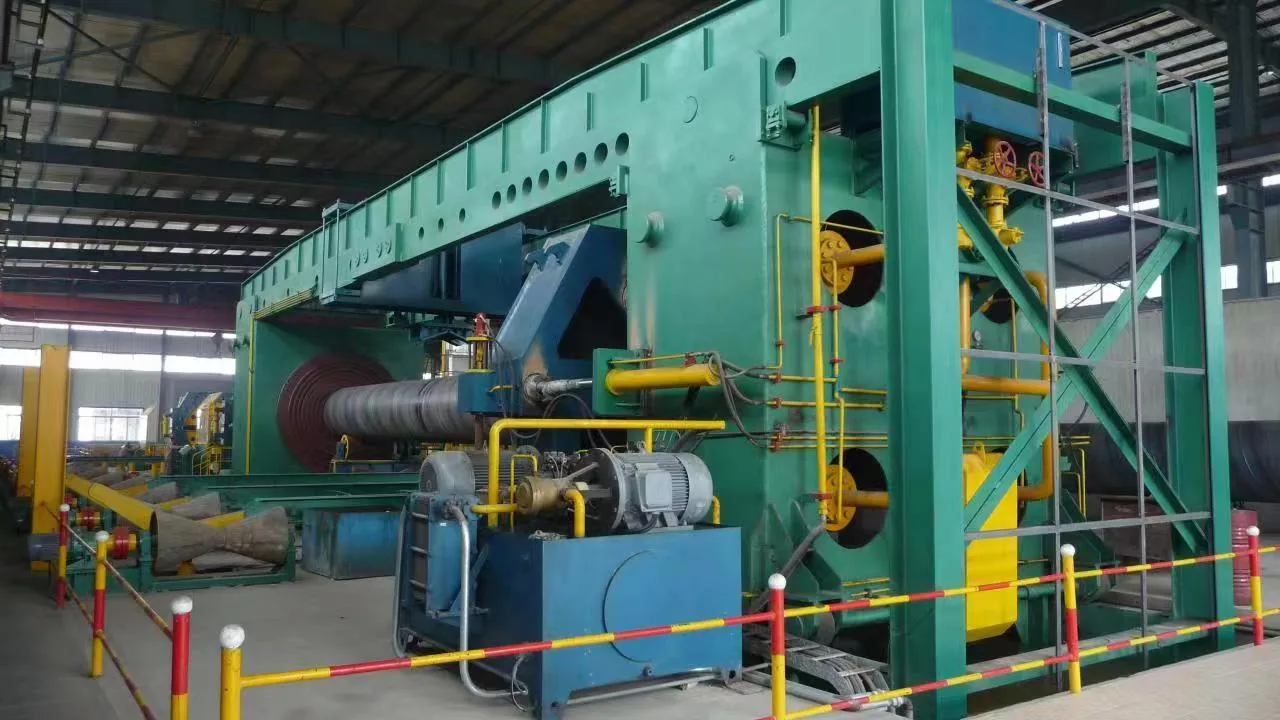
GB/T 9711 is the line pipe standard Tengtian’s SSAW spiral welded pipe mill is built and accepted against, alongside API SPEC 5L on the Φ1620 class. On the line it is cited at the X-ray and off-line ultrasonic stations of the finishing chain, after weld repair and before end facing.
What GB/T 9711 Covers
Where GB/T 9711 sits in Tengtian’s equipment:
- The Φ1620 spiral class is built against GB/T 9711 and API SPEC 5L; GB/T 9711 is also named among the operative standards of the Φ820 class.
- Acceptance of the inspection chain — X-ray, hydrostatic and off-line ultrasonic — is to GB/T 9711-2017 and API SPEC 5L (46th edition).
- The X-ray station cites GB/T 9711-2017 alongside GB/T 26830-2011 and ISO 10893-7 single-wall class B; its radiation protection is specified separately to GBZ-117-2015 and GBZ/T 250-2014.
- Non-compliance with the standard is the failure mode: missed defects or drifted calibration mean the pipe cannot be delivered to GB/T 9711 or API 5L.
Tengtian supplies the inspection stations with their indices quantified and the hydrostatic station with a printed test record. On the Φ1620 class, commissioning is carried out by five personnel — four engineers and an adjustment technician — over forty days, and the commissioning team trains the plant’s operators on the stations. Other Tengtian lines are built to a named standard in the same way: the API line pipe mill to API 5L, and the H-beam production line to GOST R 58966-2020.
Grades, Dimensions and Test Requirements
Tengtian builds two spiral classes to this standard, and they differ in size range and in how far the finishing chain goes. On both, pipe diameter is set by the forming angle, 39°–80° on the Φ820 class, rather than by changing rolls.
| Item | Φ820 class | Φ1620 class |
|---|---|---|
| Pipe range | Φ219–820 mm, wall up to 12 mm | Φ219–1620 mm, wall 5–16 mm |
| Steel grades in the capacity table | Q235 / Q355B / L360 | Q235B / Q355C / L360 |
| Operative standards | GB/T 9711 | GB/T 9711-2017 and API SPEC 5L (46th edition) |
| Finishing sequence | Weld repair → X-ray → end facing → hydrostatic test | Weld repair → pipe-end alignment → X-ray → hydrostatic test → off-line ultrasonic → end facing |
| X-ray | X-ray set (160 class) | 225 kV / 8 mA · 40 mm Fe by radiography · sensitivity 0.8–1.2% · 0.5–10 m/min |
| Hydrostatic test | 300 t press | 1200 t frame · Φ800 main cylinder · 31.5 MPa · pipes 8–12 m · printed record |
| Off-line ultrasonic | Not in the sequence | 0.5–15 MHz · weld 100% · heat-affected zone 25 mm each side · body ≥ 35% · end dead zone ≤ 300 mm |
| Weld tracking | — | Laser image acquisition |
Measurement Method and Tolerance
Acceptance to GB/T 9711 rests on a documented inspection trail rather than a single tolerance figure. The hydrostatic station runs under PLC and computer control and prints its test record, and the off-line ultrasonic station is set up against reference defects — radial through-holes of 1.6 and 3.2 mm, an N5 notch at 5% of wall thickness and a 6 mm flat-bottomed hole — with a false-call rate of no more than 2% and no missed calls on the sample pipe.
On the Φ1620 class the standard is applied in this order:
- Weld repair
- Pipe-end alignment
- X-ray inspection
- Hydrostatic test
- Off-line ultrasonic inspection
- End facing
Because weld repair comes before X-ray, repaired welds are inspected along with the rest of the seam. The ultrasonic dead zone is 300 mm or less from each pipe end.
The chain differs by line class rather than by option: the Φ820 class finishes with weld repair, X-ray, end facing and hydrostatic test, while the Φ1620 class adds pipe-end alignment and off-line ultrasonic inspection. Each station is set out in the SSAW inspection chain, and the larger class in the large-diameter SSAW line.
More in the Knowledge Base
From the Workshop
Send Your Enquiry
Tell us the pipe outside-diameter range, the wall thickness and the output you need. An engineer reads every enquiry — it does not land in a general sales inbox.